From mission to dossier in minutes.
Describe the operation. The rules engine computes iGRC, GRC, ARC and SAIL, then emits an authority-ready dossier. Every line cites its rule.
Operators decline work they could legally take because the paperwork costs more than the job.
Screen capture: an operational volume drawn on the map, contingency and buffer extruding, then the SAIL badge resolving. 12 s loop, no cursor trails.
The chain the authority will read, computed in front of you
Five determinations, each one derived from the one before it, each one traceable to the clause that produced it.
- Step 01iGRCCharacteristic dimension, speed and the population under the flight geography. Class 1–10.
- Step 02 · M1 / M2GRCGround mitigations applied at their evidenced robustness. Final ground risk class.
- Step 03ARCAirspace class, altitude band, aerodrome proximity and traffic. a, b, c or d.
- Step 04Residual ARCStrategic mitigation by operational restriction or common structure.
- Step 05 · GRC × ARCSAIL I–VISets the 17 OSOs at Low, Medium or High robustness, then containment.
Every line cites its rule
The derivation tree holds the whole determination. Each node names the rule that fired and the clause it comes from; the raw facts you confirmed sit at the leaves. A case officer can follow it without asking you a question.
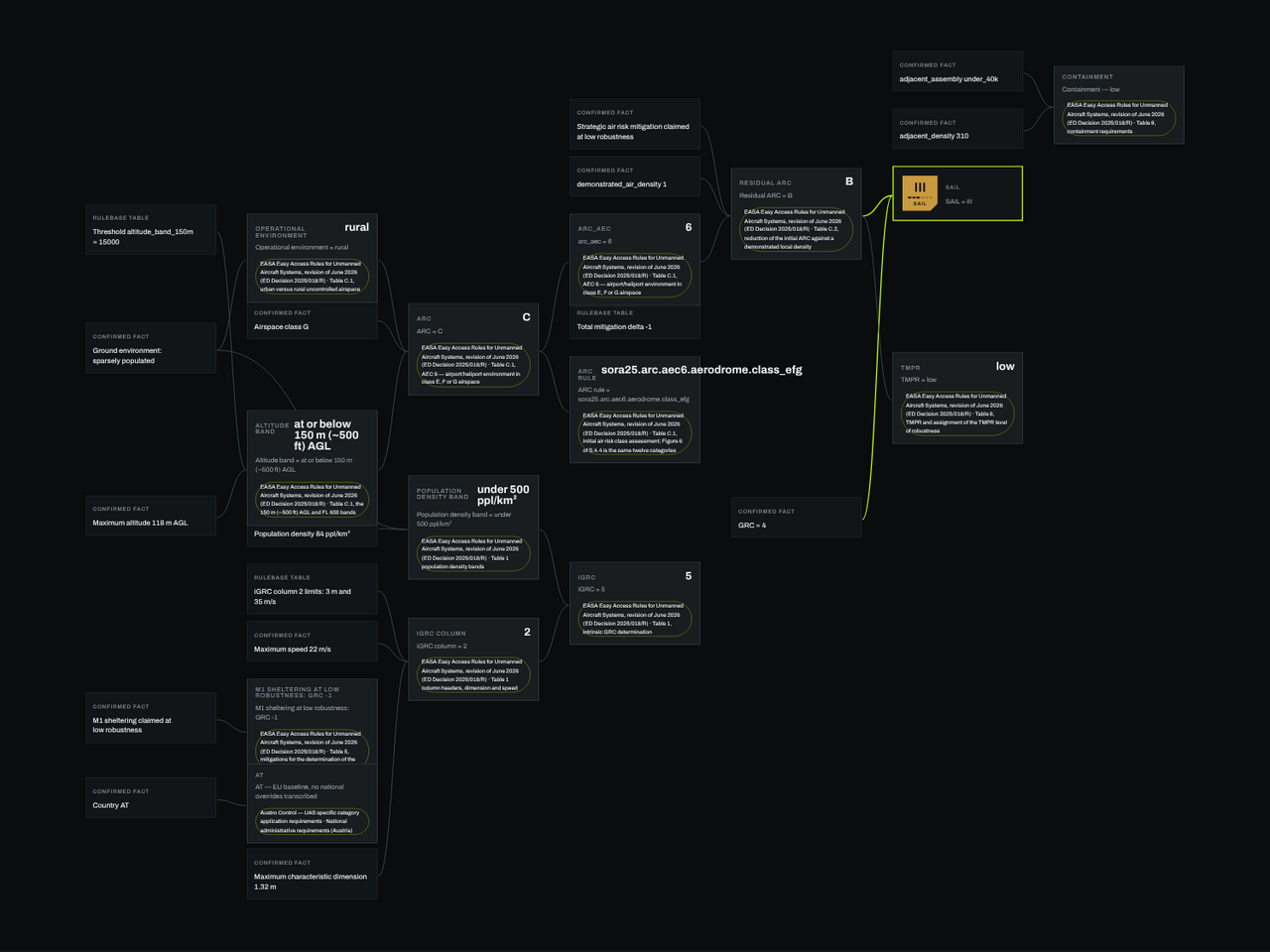
The derivation tree at full width, three nodes expanded, citations legible at 100%.
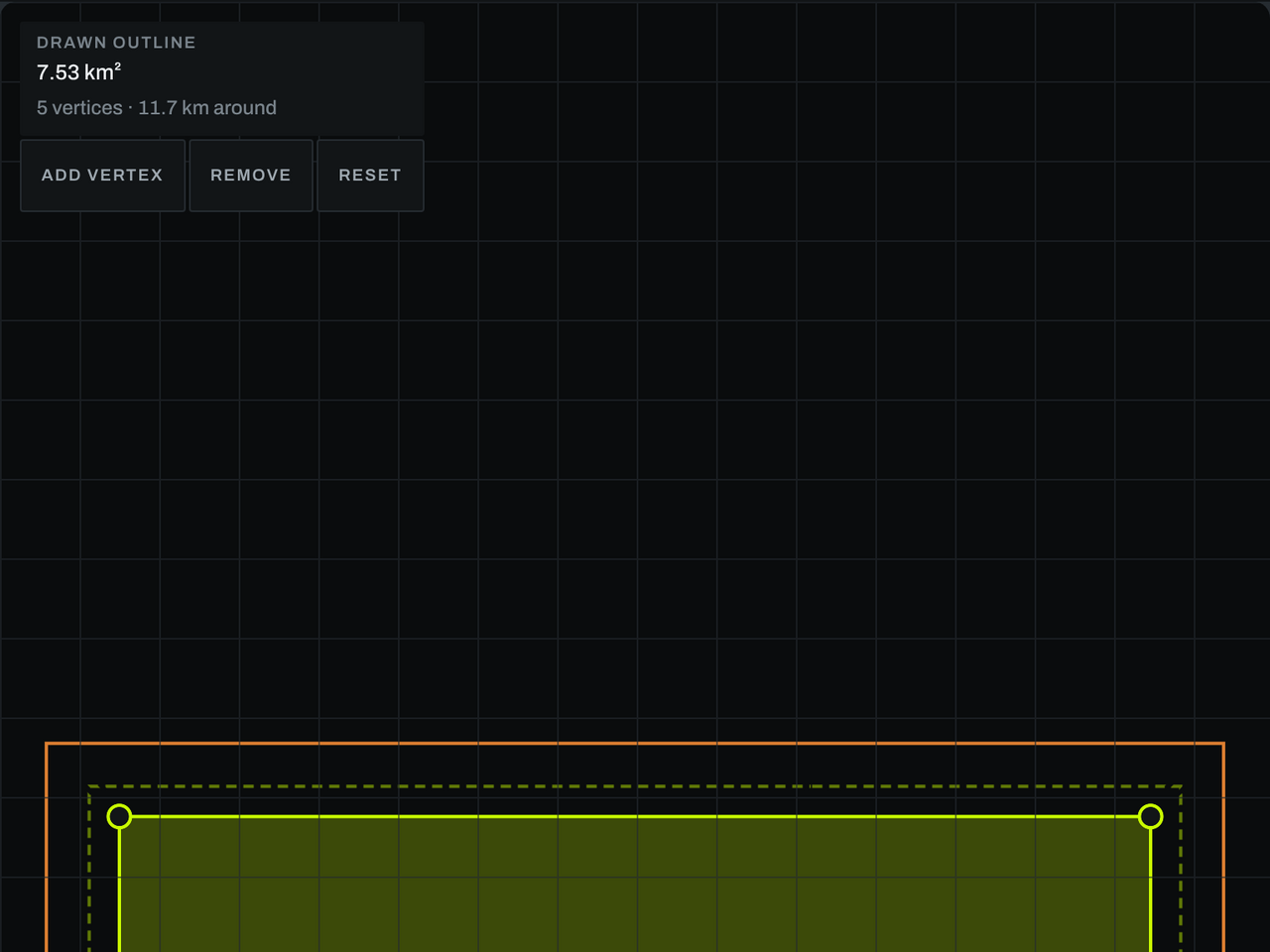
Map step with flight geography, contingency volume, ground risk buffer and the density overlay on.
Draw the flight geography. The volumes follow.
Contingency volume and ground risk buffer are derived from your aircraft's speed, altitude and response times, not typed in. Population density and ED-269 geo-zones sit underneath, so the adjacent area is visible before it becomes a finding.
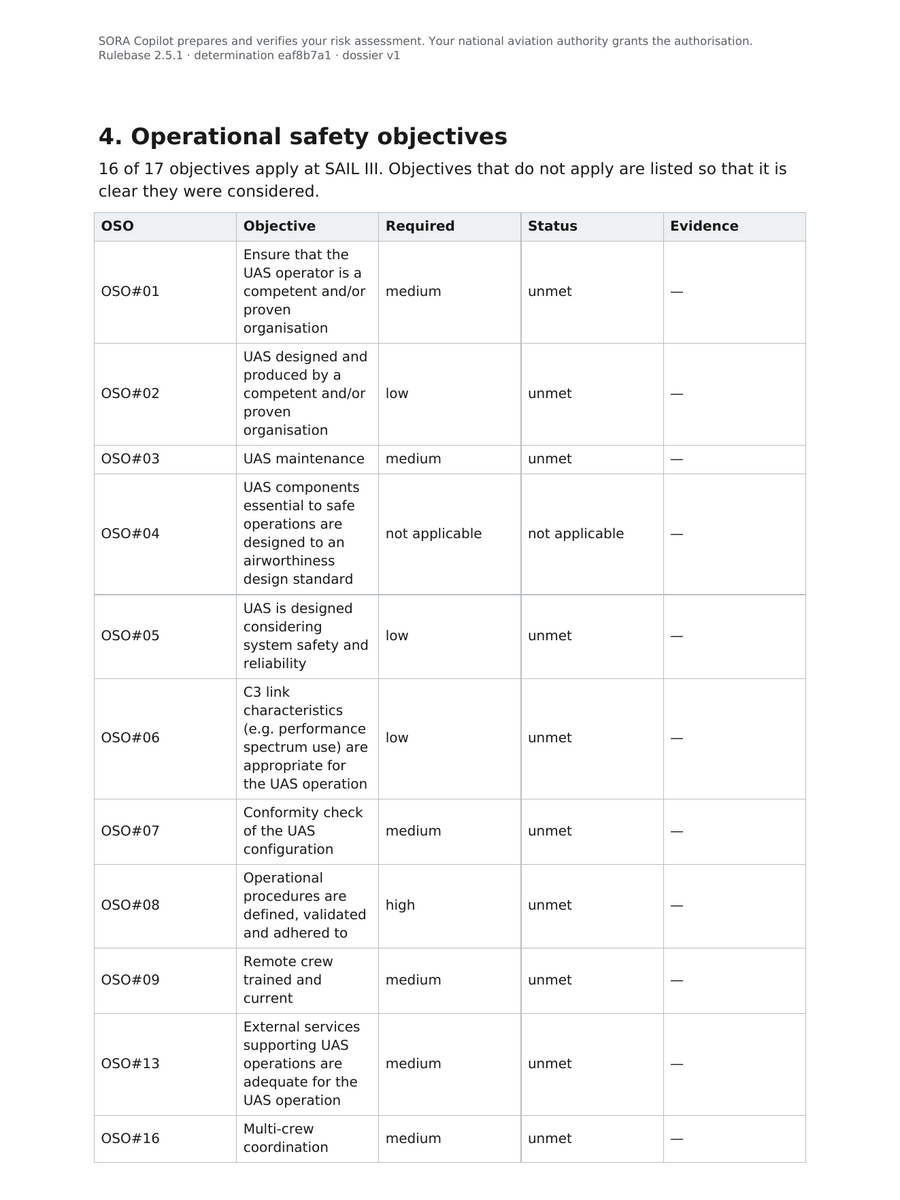
The OSO matrix page of the real generated PDF, rasterised at 160 dpi. Real typography, not a mock — a mock of your own output is the one illustration nobody needs.
The output looks like it came from an aviation professional
ConOps, the SORA assessment tables, the OSO matrix with evidence references, and an ERP skeleton. Versioned, rulebase-stamped, exported as DOCX.
Altitude parameter changing, then SAIL stepping III → II one plate at a time. 6 s loop.
When the answer is no, the advisor says what would make it yes — and applies it.
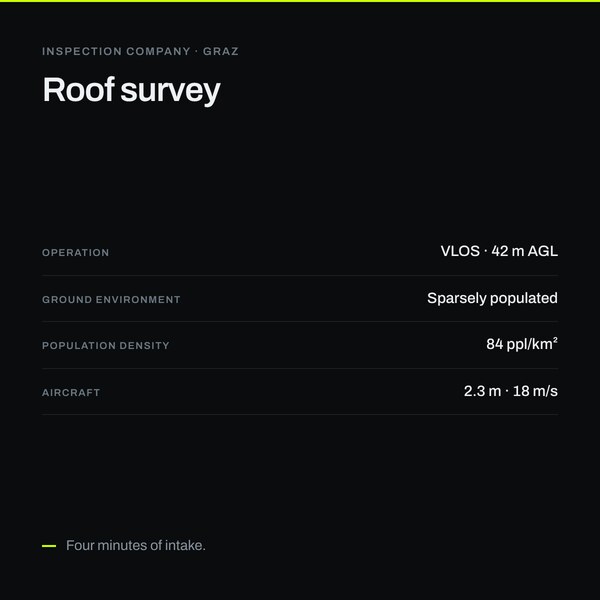
Segment card, not a photograph: the facts this segment types in. A photograph of a customer who does not exist is a fabricated endorsement, and the copy beside it describes a segment rather than quoting a person.
Inspection company, Graz. Takes the roof survey it used to decline, because the assessment now costs an afternoon.
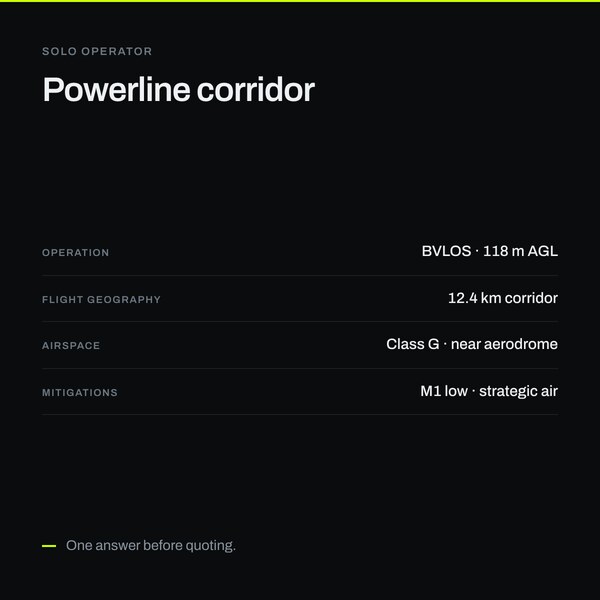
Segment card, not a photograph. Inputs only — nothing on it is a class the engine computed.
Solo BVLOS operator. Wants one answer before quoting: can this fly, and if not, what would it take.
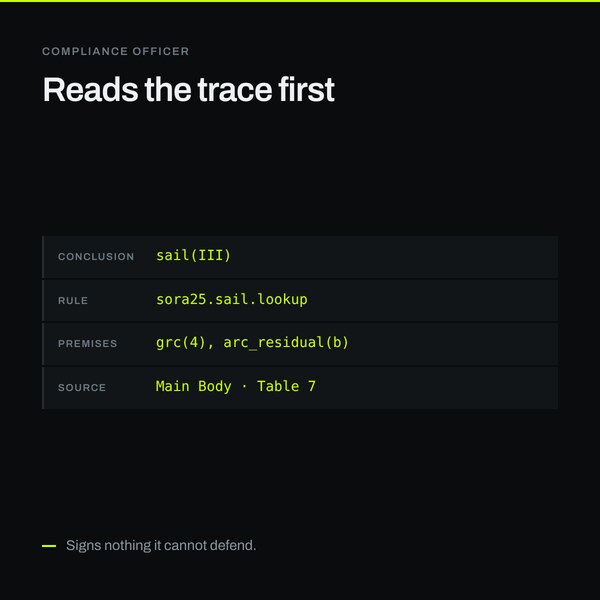
Segment card, not a photograph: the justification this reader opens before the verdict, in the shape the product actually emits it.
Compliance officer. Reads the trace before the verdict. Signs nothing that cannot be defended clause by clause.
Pricing
See full comparison- Open / specific / certified determination
- Estimated SAIL, no dossier
- No account required
- Full derivation trace
- DOCX export
- Rulebase pinning for 12 months
- Unlimited determinations
- Unlimited dossiers
- Fleet records and evidence vault
- Counterfactual advisor
- Everything in Pro
- Shared fleet and evidence
- Review and approval states
- Audit log export
- Unlimited client workspaces
- White-label dossier cover
- National annex requests
- Data region selection
Questions worth asking
No. It prepares and verifies the assessment. Your national aviation authority grants the authorisation. The disclaimer appears on the verdict screen and in every export.
The one pinned to your organisation at the moment of the run. The version and date are stamped on the determination and carried into the dossier, so a result is reproducible months later.
They arrive as unconfirmed chips. Nothing reaches the engine until you confirm it. The boundary between extraction and computation is visible in the interface.
Every node of the derivation tree names the rule that fired and cites the clause. The raw facts sit at the leaves. Expand any branch down to the input.
JARUS SORA 2.5 as adopted under EU 2019/947, with national annexes for Austria, Germany and the Netherlands. Others on request.
Marks shown for reference only. No endorsement by EASA, Austro Control or the LBA is implied or claimed.

The regulations themselves, set as type — never a reproduction of an authority's logo, which would read as endorsement next to a line saying none is implied.